
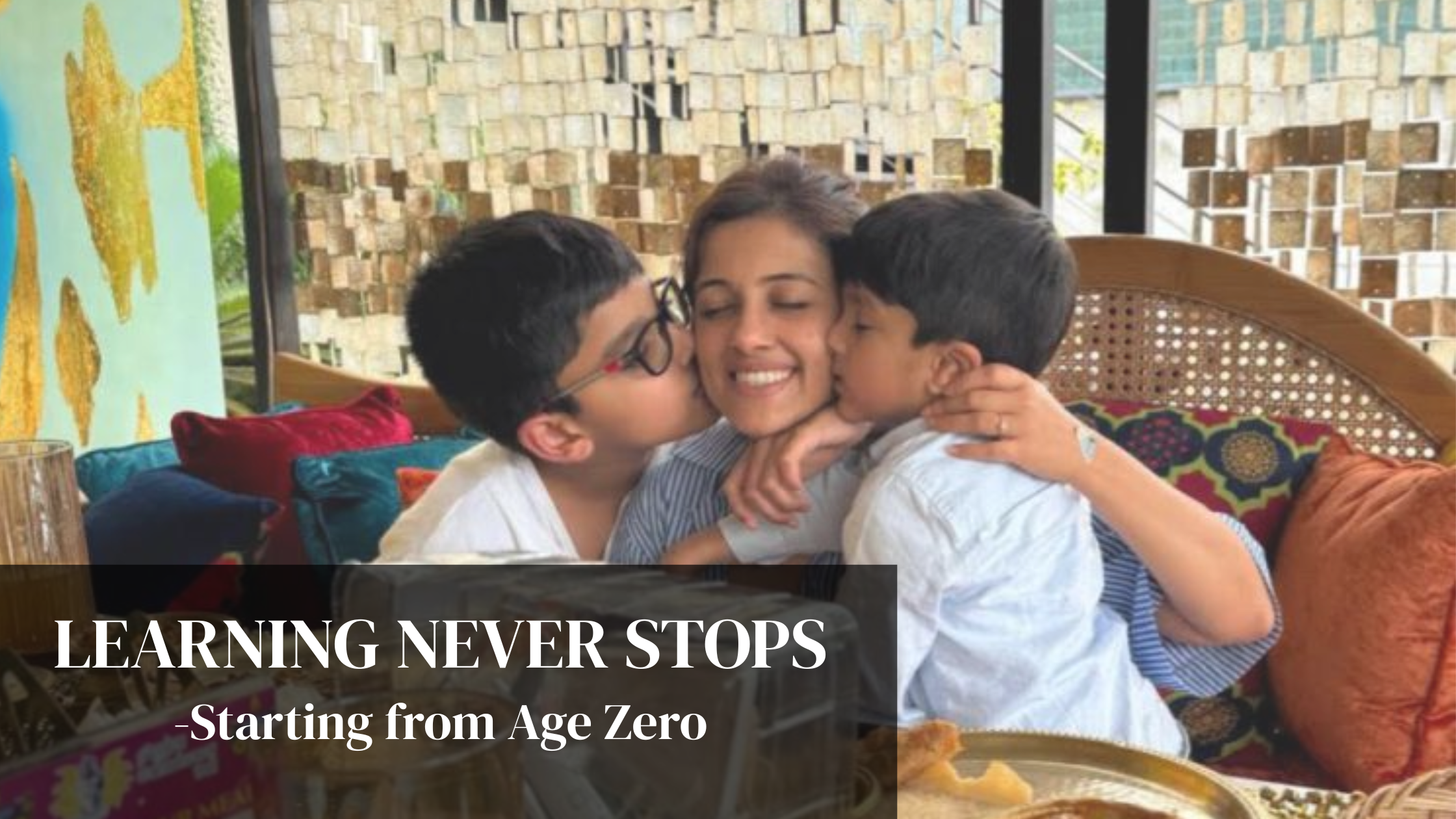
When is it too early to teach my child? As a parent and a teacher of three children, this is the question that I have been asked more than once. And my answer to this question has always been the same. Young people never cease to learn. Their heads start embracing sounds, patterns, expressions, and emotions as soon as they are born into this world. It is not the time of learning that is actually the question. Whether we as parents and educators are making the appropriate environment in which it can thrive.
Learning is not a milestone. It is a ride that goes through all the childhood moments. And knowing this, we come to realize that the first years are the best in terms of growth.
A child will not wait until he or she receives a school admission or a formal lesson to start learning. Their initial steps and their initial words, and their initial efforts to build blocks or to grasp a spoon are all strong demonstrations of natural learning. They do it without fear, without manual, and with will, which most adults eventually lose.
This is a beautiful truth that is supported by science. It has been found that the brain grows best during the first three years of life, and this stage of life (zero-eight years old) is the one that determines the cognitive, social, emotional, and physical growth more than any other stage. Children have multiple senses of learning. They watch the surroundings, imitate what they observe, experiment, fail, and repeat, and gradually develop their knowledge.
This early foundation is given a lot of importance by parents. Confidence is inspired through encouragement. Resilience is achieved through motivation. Emotional strength is developed through care. Our smiles at their efforts, warmly addressed communications, responding to their inquisitiveness, and provision of secure environments in which to experiment, all render the process of learning a normal aspect of life.
We have no reason to begin educating our children. They are already learning. It is upon us to encourage that instinct of nature.
The first classroom that a child has is play. It is where fantasy is combined with action, where exploration is combined with creativity, and where error is considered a stepping stone. A child does not require instructions on how to build blocks or puzzles. They take them, roll them, pile them, smash them, do it again, and finally make it. Through that process, they get to learn problem-solving, attention, rationality, spatial awareness, and strength.
Hands-on learning is effective as it is similar to how children are able to explore the world they live in. The research in the field of developmental psychology is unanimous that the benefits of childhood play are the enhancement of cognitive flexibility, emotional balance, and flexible problem-solving in adulthood. Children do not play just because they pretend to be astronauts, teachers, or scientists. They are exploring the possibilities and creating neural connections that determine innovativeness in the future.
Fantasy is not a distraction. It is an effective tool for learning. It feeds cognitive development, promotes creative thinking, and empowers dreaming and experimentation. Play-based learning allows the children to be engineers, architects, artists, and storytellers in one. And there is the strength of the playful discovery.
Provide a child with a set of blocks, and you will observe how effortlessly design, logic, and creativity will be combined. This is the learning in its purest sense.
Where learning is the engine of play, curiousness is the fuel. Inquisitiveness starts as soon as a child knows how to talk. You realize the most frequent questions in any home soon. Why is the sky blue? Why do trees have leaves? Why do animals sleep? Why does kindness matter? The opening of every why is a door to discovery.
Every day, children pose hundreds of questions beginning with why and how. These questions demonstrate that there is an active mind that is willing to know the world. We ought to promote research as opposed to providing instant solutions. We are able to make learning out of the ordinary. A crawling insect in the garden can create a lesson on the topic of ecosystems. Geometry can be added to the shapes in the kitchen. Light can be discussed with the help of shadows on the wall.
Children learn to think critically when they are informed that they are allowed to ask questions. They learn to observe, explore, and reason. The home and the classroom should not be where the why questions are shunned, but they are cheered. I support all that at Byjus and in my place of residence because every why brings about some discovery, and discovery is the basis of lifelong learning.
Curiosity makes children no longer learned but be motivated. Questioning children become innovative adults.
With the changing nature of learning, children’s experience is being changed by a new approach. Phygital learning combines all the physical play with digital interaction to produce a learning experience that is natural, interactive, and personal. This is not the purpose of replacing toys with screens. It is to bring together the best of the two worlds.
Physical play assists in the development of motor play, imagination, and creativity. Online resources provide real-time feedback, customized instructions, and challenging problems. There is more effective learning when the two collaborate with one another.
The idea of teaching fractions by cutting a cake into whole and allowing the children to touch and see the parts, and supporting the idea with the help of a digital tool, all in interactive activities. The combination of practical learning with individualized digital feedback makes the learning easier. Technology helps to improve learning, but it can never substitute the importance of touch, play, and exploration.
Phygital learning assists children to learn at their own pace, interest, and style. It is the future of early education and a change of glee as well as richness to every learning experience.
The period of childhood is one of the most significant in the formation of learning. The right learning inputs during childhood stay with children for life. Let’s make those inputs joyful, engaging, and playful so that children at such a young age determine the way children think, feel and how they explore the world. Children will naturally develop confidence, creativity, and compassion when learning is made joyful, engaging, and full of mere curiosity.
Parents and teachers play a significant role in creating environments where discovery is possible. The children can learn without fear because of the gentle guidance and encouragement of answers and play. Each moment is an opportunity to experience something new, and each day is an offer to learn the world a little better.
Childhood has an effective growth opportunity. Learning will be a strength, interest, and inspiration throughout life when it is continuous and joyful, and fun.